

Medical Coding Services vs. In-House Coding: Which Is Better for Your Practice?
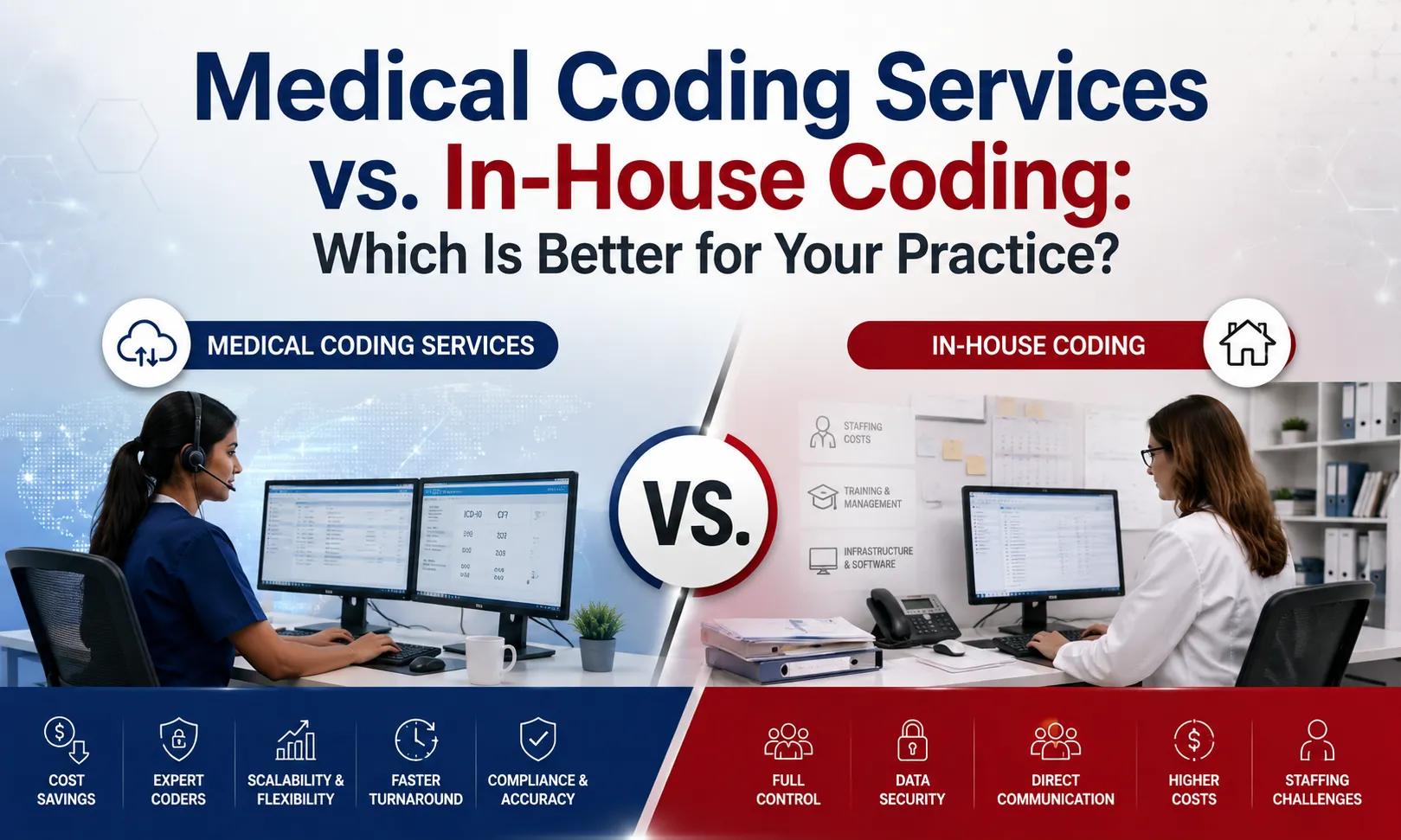
Medical coding plays an important role in healthcare revenue cycle management. Accurate coding helps healthcare providers report diagnoses and procedures correctly, submit cleaner claims, support appropriate reimbursement, and maintain compliance with coding requirements.
For many healthcare practices, an important question is whether to manage coding internally or outsource it to a professional medical coding service. Both options have advantages and challenges. The right choice depends on your practice size, specialty, coding volume, staffing resources, budget, and long-term goals.
In this guide, we compare medical coding services vs. in-house coding and explain which option may be better for your practice.
What Are Medical Coding Services?
Medical coding services involve reviewing clinical documentation and assigning appropriate diagnosis and procedure codes. Professional coders commonly work with ICD-10-CM, CPT, and HCPCS coding systems.
Outsourced medical coding services may include:
ICD-10-CM coding
CPT and HCPCS coding
Evaluation and Management (E/M) coding
Specialty-specific coding
Chart review
Coding audits
Documentation review
Quality assurance
Coding compliance support
Accurate coding is essential because errors or incomplete coding can contribute to claim denials, payment delays, and additional administrative work.
What Is In-House Medical Coding?
In-house medical coding means employing and managing coders directly within your organization. These professionals may work onsite or remotely but remain part of your internal team.
With an in-house model, the practice generally handles recruitment, salaries, benefits, training, technology, performance management, continuing education, and quality monitoring.
This approach can provide strong internal control, especially for larger healthcare organizations with consistent coding volumes and established revenue cycle departments.
Outsourced Medical Coding vs. In-House Coding
The main difference is how coding resources are managed.
Outsourced medical coding gives practices access to external coding professionals without requiring them to build and manage a complete internal team. In-house coding gives the organization direct control over employees, workflows, and daily operations.
Neither model is automatically better. The best option depends on the practice's operational requirements.
Benefits of Outsourced Medical Coding
1. Access to Experienced Coders
A professional medical coding company can provide access to trained coders with experience in different specialties and documentation scenarios. This can be valuable for practices dealing with complex or specialty-specific coding requirements.
2. Reduced Staffing Responsibilities
Hiring and retaining qualified medical coders can require significant time and resources. Outsourcing can reduce responsibilities related to recruitment, onboarding, employee management, training, and replacement hiring.
This allows practice managers to focus more on patient care, business operations, and other revenue cycle activities.
3. Greater Scalability
Coding volume can change as a practice grows, adds providers, opens new locations, or experiences seasonal increases in patient volume.
Outsourced medical coding services can provide additional capacity without requiring the practice to immediately hire more full-time employees.
4. Potential Cost Savings
The cost of an in-house coding department includes more than employee salaries. Practices may also pay for benefits, payroll taxes, software, hardware, training, office resources, continuing education, and management.
Outsourcing can reduce some of these overhead responsibilities. However, practices should compare the total cost and service quality before selecting a vendor.
5. Specialty Coding Expertise
Healthcare specialties often have different documentation and coding requirements. A qualified outsourcing partner may provide coders experienced in areas such as cardiology, behavioral health, orthopedics, pain management, internal medicine, radiology, and other specialties.
Benefits of In-House Medical Coding
1. Direct Management
With internal coders, management has direct control over staffing, workflows, schedules, productivity expectations, and quality standards.
2. Easier Internal Communication
In-house coders can communicate directly with providers and billing teams when documentation questions arise. Strong internal communication can help resolve issues quickly.
3. Greater Operational Control
Some healthcare organizations prefer keeping coding internally because they want complete control over training, processes, quality assurance, and employee performance.
4. Institutional Knowledge
Long-term employees can become familiar with the organization's providers, documentation habits, specialties, and internal processes. This knowledge may improve workflow efficiency over time.
Which Is More Cost-Effective?
There is no universal answer to whether outsourced or in-house medical coding is cheaper.
For a small or growing practice, outsourcing may be more practical because the organization does not need to establish a complete coding department. Larger healthcare organizations with high and predictable coding volumes may find that maintaining an internal team makes sense.
When comparing costs, consider:
Employee salaries and benefits
Recruitment and hiring
Training and education
Coding software
Technology
Quality assurance
Management time
Employee turnover
Coding volume
Vendor fees
The goal should not simply be finding the lowest price. Practices should evaluate the overall value, coding accuracy, scalability, and operational support.
When Should You Outsource Medical Coding?
Outsourced medical coding may be a good option if your practice:
Has difficulty recruiting qualified coders
Experiences coding backlogs
Has increasing claim volume
Needs specialty coding expertise
Wants to reduce administrative workload
Needs flexible coding support
Is experiencing employee turnover
Wants additional quality control
Is expanding its provider network
Small and independent practices can especially benefit when maintaining a full-time internal coding department is difficult or expensive.
When Is In-House Coding Better?
In-house coding may be suitable when your organization has:
Consistently high coding volume
Experienced coding management
Sufficient internal resources
Established quality assurance processes
Strong internal training programs
Existing coding technology
A need for direct employee management
For large healthcare organizations, internal coding teams can provide consistency and strong institutional knowledge.
What About a Hybrid Coding Model?
Practices do not always have to choose one model exclusively. A hybrid medical coding model combines internal coders with outsourced coding support.
For example, a practice may use internal coders for routine claims while outsourcing overflow work, coding audits, specialty coding, temporary backlogs, or additional support during periods of increased volume.
This model can provide flexibility while maintaining an internal coding team.
How to Choose a Medical Coding Company
If you decide to outsource, evaluate potential vendors carefully. Look for:
Experienced and qualified coders
Specialty-specific expertise
Quality assurance processes
Secure handling of healthcare information
Clear turnaround times
Transparent reporting
Strong communication
Scalable services
Compliance-focused workflows
A reliable medical coding services company should understand your specialty, workflow, documentation requirements, and revenue cycle goals.
Medical Coding Services from Revantage Healthcare Business Solutions LLC
Revantage Healthcare Business Solutions LLC provides healthcare revenue cycle support designed to help medical practices improve efficiency and manage their billing and coding operations. Our services include medical billing and coding, accounts receivable follow-up, denial management, credentialing and enrollment, prior authorization, benefits verification, and other RCM solutions.
By combining experienced professionals with structured workflows, Revantage Healthcare Business Solutions LLC helps healthcare providers reduce administrative burdens and strengthen their revenue cycle processes. Whether your practice needs ongoing outsourced medical coding or additional support during periods of increased volume, our solutions can be tailored to your operational needs.
Frequently Asked Questions
Is outsourced medical coding better than in-house coding?
It depends on your practice. Outsourcing may provide greater scalability and specialized expertise, while in-house coding offers direct management and internal control.
What are the benefits of outsourcing medical coding?
Benefits can include access to experienced coders, reduced staffing responsibilities, flexible capacity, specialty expertise, and potentially lower operational overhead.
Can small practices outsource medical coding?
Yes. Outsourcing can be especially useful for small practices that do not have enough coding volume or resources to maintain a full internal coding department.
Can a practice use both in-house and outsourced coders?
Yes. A hybrid model can provide internal control while giving the practice additional support for overflow, audits, specialty coding, or temporary increases in workload.
Final Thoughts
Choosing between medical coding services and in-house coding depends on your practice's size, coding volume, staffing capabilities, specialty, budget, and growth plans.
In-house coding offers direct control and institutional knowledge, while outsourced medical coding can provide scalability, specialized expertise, and reduced administrative responsibilities.
For many growing healthcare practices, outsourcing can be an efficient way to strengthen coding operations without building a large internal department. The best solution is the one that supports accurate coding, efficient workflows, compliance, and a healthier revenue cycle.